
Namaz Lesson Online: Learn to Pray Salah Step by Step With a Teacher
A namaz lesson teaches you how to perform the Islamic prayer (salah) correctly, from wudu and the prayer positions to what to recite in each step, with a teacher who watches, listens and corrects you. At Muqadas Quran Academy, you learn namaz in live one-to-one lessons, at your own pace, whether you are a complete beginner, a new Muslim, a parent or a student.
You do not need any previous knowledge. We start from the very first step and build up until you can pray with confidence.
✓ Live 1-on-1 Video Lessons ✓ Beginners, Kids & New Muslims ✓ English, Urdu & Arabic Support

Why Learn Namaz With a Teacher?
Many people try to learn from pictures, PDFs or apps. These are useful, but prayer has details that are easy to get wrong without feedback: pronunciation, positions, timing and order. A teacher helps you because they can:
- ✓ Hear your recitation and correct pronunciation.
- ✓ See your positions over video and guide you.
- ✓ Answer your questions about what you do not understand.
- ✓ Build your confidence, so you stop worrying about making mistakes.
What Does the Namaz Course Cover?
Your teacher adapts the pace to your level. A typical path includes:
- ✓ Purification: wudu (ablution) and when ghusl is needed.
- ✓ Conditions of prayer: what must be in place before you pray.
- ✓ The five daily prayers: names, times and number of units (rakat).
- ✓ Step-by-step prayer: from the intention to the final salam.
- ✓ What to say during namaz: the recitations and supplications, with meaning.
- ✓ Learning to recite correctly: Al-Fatihah and short surahs with correct pronunciation.
- ✓ Common mistakes: and how to correct them.
- ✓ Other prayers: such as Witr, Jumu’ah and Eid, as you progress.
- ✓ Guidance for sisters: specific rulings and practical advice.
- ✓ Review: praying in front of your teacher until you are confident.

How to Learn Namaz Step by Step
This is a general overview to help you understand what you will learn. Your teacher will teach each step in detail and according to the school of thought you follow, since small details differ.

Before You Pray
- ✓ Be in a state of purity. Perform wudu (and ghusl if required).
- ✓ Make sure your clothes, body and place are clean and your clothing covers what must be covered.
- ✓ Know the time of the prayer.
- ✓ Face the Qibla, the direction of the Kaaba in Makkah.
- ✓ Make the intention in your heart.
The Prayer (One Unit, or Rak'ah)
- ✓ Takbir: Raise your hands and say “Allahu Akbar” to begin.
- ✓ Standing (Qiyam): Recite the opening supplication [varies by school], then Surah Al-Fatihah, then another passage from the Quran.
- ✓ Bowing (Ruku): Say “Allahu Akbar”, bow and say the praise of Allah in bowing.
- ✓ Rising: Stand up from bowing with the words of praise.
- ✓ Prostration (Sujud): Go down, placing forehead, nose, palms, knees and toes on the ground, and say the praise of Allah in prostration.
- ✓ Sitting between the two prostrations, then the second prostration.
- ✓ Repeat for the following units as required.
- ✓ Sitting for the Tashahhud: Recite the testimony of faith and salutations on the Prophet [wording varies by school].
- ✓ Salam: End the prayer by turning your face to the right and then the left with the salam.
Every school teaches slight differences, for example in hand position, some recitations and the details of certain postures. Your teacher explains your school’s method clearly, so you are never confused.
What Are the 5 Types of Namaz? The Five Daily Prayers
The five daily prayers are:
| Prayer | Time (general) | Obligatory units (rakat) |
|---|---|---|
| Fajr | Dawn until sunrise | 2 |
| Dhuhr | After midday | 4 |
| Asr | Afternoon | 4 |
| Maghrib | After sunset | 3 |
| Isha | Night | 4 |
Besides these, there are additional prayers, such as Witr, Jumu’ah (Friday prayer) and Eid prayers, and voluntary prayers. Exact times change with location and season, so use a reliable prayer timetable for your city.
What to Say During Namaz
You recite in Arabic, and your teacher helps you learn each part. Common parts include:
- ✓ “Allahu Akbar” to begin and move between positions
- ✓ Surah Al-Fatihah and another passage of the Quran in standing
- ✓ The praise of Allah in bowing and prostration
- ✓ The Tashahhud and salutations on the Prophet (peace be upon him)
- ✓ The salam to end
To pronounce these correctly, many students combine namaz lessons with our Quran reading course or Tajweed course. To understand what you say, see our Quran translation course.
Common Mistakes Beginners Make
- ✓ Rushing through positions without calm and stillness
- ✓ Mispronouncing letters in Al-Fatihah
- ✓ Forgetting the order of the steps
- ✓ Unclear intention or distraction in prayer
- ✓ Uncertainty about wudu details or what breaks it
- ✓ Not knowing what to do after a mistake in the prayer
A teacher helps you fix these early, before they become habits.
Who Is This Course For?
- ✓ Complete beginners: No knowledge needed. See our online Islamic classes (Fundamentals of Islam).
- ✓ New Muslims: A gentle, judgement-free start, with clear English explanations.
- ✓ Adults: A private, respectful space. See our online Quran classes for adults.
- ✓ Children: Short, engaging lessons for kids. See our online Quran classes for kids.
- ✓ Sisters: Female students can choose a female teacher and receive guidance specific to women. See our online Quran classes for ladies.
- ✓ Families: Parents and children can learn together.
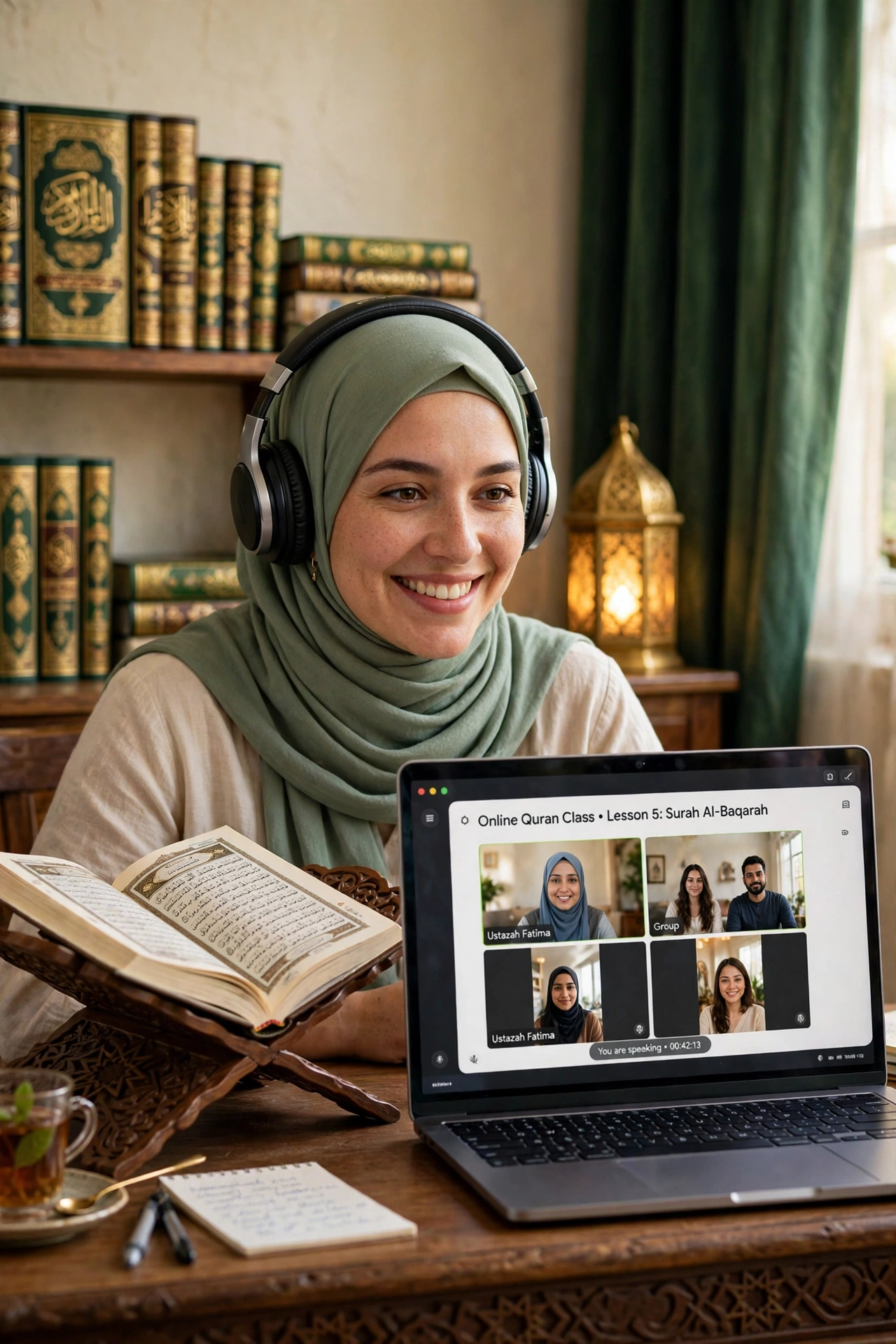
Our Teachers
Your teacher is the most important part of your learning. Our tutors:
- ✓ Hold qualifications in Islamic studies and Quran recitation
- ✓ Are transparent about differences between schools of thought
- ✓ Are experienced in teaching beginners, children and new Muslims
- ✓ Include male and female teachers
- ✓ Are tested through a live teaching demo
Meet our teachers: a female Quran tutor or a male Quran tutor — tell us your preference when you book.
How Our Online Namaz Lessons Work
Book a free trial
Message us or fill in the form.
Assessment
The teacher learns your level and goals.
Personal plan
You get a schedule and a learning path.
Live 1-on-1 lessons
Lessons over video call, where you pray and your teacher guides you.
Practice
Small daily tasks, such as memorizing a recitation.
Progress updates
Regular feedback for you or your family.
You only need a phone, tablet or computer, a stable internet connection, a clean prayer space and a prayer mat.
Course Details at a Glance
| Detail | Information |
|---|---|
| Course | Namaz lesson online (Professional Namaz Course) |
| Class type | Live 1-on-1 over video call |
| Class length | 30 minutes |
| Prerequisites | None |
| Teachers | Male and female, qualified |
| School of thought | Taught according to the school of thought you follow |
| Language support | English, Urdu and Arabic, depending on the teacher |
| Schedule | Flexible, in your time zone |
| Trial | Free trial lesson |
Fees and Plans
Choose the plan that fits your schedule. All plans include live 1-on-1 lessons with a qualified teacher.
Starter
Best for: Light schedule.
- ✓ 8 classes per month
- ✓ 30 min
- ✓ First class free
Standard
Best for: Steady progress.
- ✓ 12 classes per month
- ✓ 30 min
- ✓ First class free
- ✓ 20% family discount
Intensive
Best for: Faster progress.
- ✓ 20 classes per month
- ✓ 30 min
- ✓ First class free
- ✓ 20% family discount
Price: Fees: Starter $35/month (8 classes) • Standard $50/month (12 classes) • Intensive $75/month (20 classes). Other currencies: GBP £28/£39/£59, CAD CA$48/CA$68/CA$102, AUD A$54/A$76/A$114, AED AED 129/184/275, PKR PKR 9,800/14,000/21,000. Your first class is free. Family discount: 20% for siblings or family members.
Frequently Asked Questions About Namaz Lessons
Answers about namaz lessons, wudu, what to say in prayer and getting started.
Start Learning Namaz Today
Prayer is the heart of a Muslim’s day. Book a free trial lesson, meet your teacher and take the first step toward praying with confidence.
Book Your Free Trial Class
Meet your qualified Professional Namaz teacher 1-on-1 over video call. No payment or card required.
JazakAllah Khair! Trial Requested
Our academic coordinator at Muqadas Quran Academy will message you shortly to confirm your preferred Professional Namaz trial slot.