Meet your certified teacher 1-on-1 over video call. No payment or credit card required. Fill in the details below and we will confirm your slot on WhatsApp.
✓
JazakAllah Khair!
Your booking request has been sent. We will contact you on WhatsApp within 24 hours to confirm your free trial class.
Online Arabic Grammar Course: Learn Nahw and Sarf to Understand the Quran
An online Arabic grammar course teaches you how Arabic sentences and words work, through Nahw (syntax) and Sarf (word forms), in live lessons with a qualified teacher, so you can read, understand and analyze Arabic text, especially the Quran. At Muqadas Quran Academy, you study step by step from the basics to advanced levels, with a clear syllabus, regular practice and correction from your teacher.
The course is open to beginners, non-Arabs and advanced students. You should be able to read the Arabic letters, and we help you get there if you cannot yet.
✓ Live 1-on-1 Video Lessons ✓ Beginner to Advanced ✓ Free Trial and Placement Test
📖
Nahw & Sarf
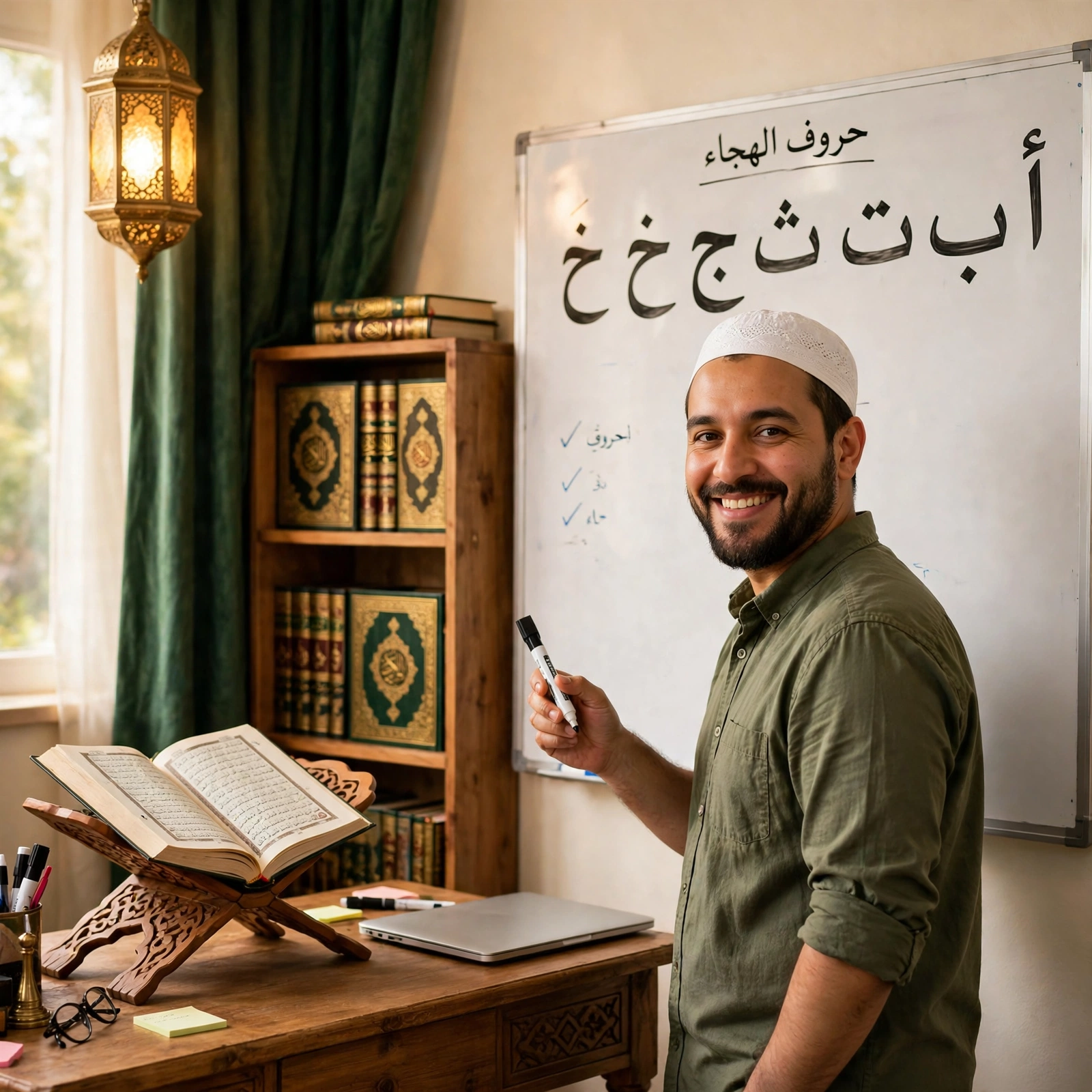
Screen-Shared Arabic Grammar Lessons
1st Class Free
Table of Contents
What Is Arabic Grammar?
Nahw vs Sarf: What Is the Difference?
Why Learn Arabic Grammar?
Course Levels and Syllabus
A Quick Look at Arabic Grammar (Examples)
Skills You Will Build
Who Is This Course For?
How Long Does It Take?
Our Teaching Method
Our Teachers
Fees and Plans
FAQs
Nahw & Sarf • Live 1-on-1
What Is Arabic Grammar?
Arabic grammar is the system of rules that governs how Arabic words are formed and how they combine into correct sentences. It is what lets you understand who did what to whom in a sentence, and why a word has a particular ending.
Classical Arabic grammar has two main branches:
Nahw (syntax): how words relate to each other in a sentence, including word endings (i’rab) that show the role of each word.
Sarf (morphology): how words are built from roots and patterns, and how they change form.
You may also see it searched as learn Arabic grammar, Arabic grammar classes, Arabic grammar lessons or sarf and nahw course. All refer to this subject.
Nahw vs Sarf
Nahw vs Sarf: What Is the Difference?
Point
Nahw (Syntax)
Sarf (Morphology)
Focus
How words work together in a sentence
How a single word is built and changes
Key topics
Sentence types, case endings (i’rab), subject, object, possession
Roots, verb patterns, tenses, singular and plural forms
Question it answers
“What is the role of this word here?”
“What is this word’s root and form?”
Helps you
Understand sentence meaning and endings
Understand vocabulary and word families
Nahw and Sarf work together. Many students begin with Nahw for sentence structure and add Sarf as they go, or study both in parallel, depending on the teacher’s method.
Grammar for Quran Understanding
Why Learn Arabic Grammar?
📖
To understand the Quran more deeply
To understand the Quran more deeply. Grammar helps you see why a verse says what it says, beyond a translation.
📚
To read Islamic texts
To read Islamic texts. Hadith, tafseer and classical books use classical Arabic.
🔤
To learn vocabulary faster
To learn vocabulary faster. Roots and patterns let you guess the meaning of many words.
✓
To stop guessing
To stop guessing. Rules give you confidence instead of memorizing sentences.
🎓
To prepare for advanced study
To prepare for advanced study in Tafseer, Hadith and fiqh.
Do I Need Nahw to Understand the Quran?
You do not need grammar to recite the Quran or to benefit from a good translation. Grammar becomes valuable if you want to understand the Arabic text itself, notice nuances that translations may not capture and study tafseer in depth. Many students start with a Quran translation course and then add grammar.
Quranic & Modern Arabic
Quranic Arabic vs Modern Arabic
Many learners ask about the difference between the Arabic of the Quran and modern Arabic. In short:
The Quran is in classical Arabic, which is the base of Arabic grammar rules.
Modern Standard Arabic (used in news and books today) comes from classical Arabic and shares its grammar, with differences in vocabulary and style.
Spoken dialects differ widely by region and are not what the Quran uses.
Because the grammar is largely shared, learning classical Arabic grammar helps with both Quranic and modern written Arabic. Your teacher will explain how the two connect.
Arabic Grammar Examples
A Quick Look at Arabic Grammar
Here is a small taste of what you will learn.
Sentence structure (Nahw): كَتَبَ الطَّالِبُ الدَّرْسَ Kataba at-talibu ad-darsa. “The student wrote the lesson.”
This is a verbal sentence: it has a verb (kataba, “wrote”), a doer (at-talibu, “the student”) and the thing the verb acted on (ad-darsa, “the lesson”). The word endings show each word’s role. The doer ends in “-u” and the object ends in “-a”. This is what Nahw teaches you to read.
Word building (Sarf): Many Arabic words come from a three-letter root. For example, the root ك ت ب (k-t-b), about writing, gives:
kitab (book)
katib (writer)
maktab (office or desk)
maktaba (library)
yaktubu (he writes)
Once you see roots and patterns, you can recognize families of words, which makes vocabulary far easier. This is what Sarf teaches you.
Levels & Syllabus
Course Levels and Syllabus
Your teacher assesses you in a free placement test and places you at the right level.
Grammar supports all four language skills, with different emphasis:
Skill
How the course helps
Reading
Read Arabic text with correct understanding of word roles and endings
Understanding (listening)
Recognize structures and word forms when you hear them
Writing
Form correct sentences and word endings
Speaking
Build correct sentences, with more practice in conversation courses
This is a grammar-focused course, mainly strengthening reading and understanding. For speaking practice, we recommend adding conversation classes — ask your teacher what is available.
Open To Every Learner
Who Is This Course For?
👶
Beginners and non-Arabs
Beginners and non-Arabs who want a structured start. See our Quran reading course for beginners.
Fees: Starter $35/month (8 classes) • Standard $50/month (12 classes) • Intensive $75/month (20 classes). Other currencies: GBP £28/£39/£59, CAD CA$48/CA$68/CA$102, AUD A$54/A$76/A$114, AED AED 129/184/275, PKR PKR 9,800/14,000/21,000. Your first class is free. See the Pricing page for current plans.
Frequently Asked Questions About the Arabic Grammar Course
Answers about the Arabic Grammar course, online classes, and getting started.
Nahw is Arabic syntax: how words work together in a sentence, including the endings that show each word's role. Sarf is morphology: how words are built from roots and patterns and how they change form. Both are needed for a full understanding of Arabic.
Study step by step with a qualified teacher, starting with the basics of nouns, verbs and simple sentences, then Nahw and Sarf in order. Practice with examples from the Quran, review often and ask questions as you go. A structured course keeps you from skipping steps.
It depends on your level and practice. Many students need a few months for the foundations and a year or more for a solid working base. Your teacher will give a realistic estimate after your placement test.
Not to recite it or to benefit from a good translation. Grammar helps you understand the Arabic text itself and the nuances in it. Many students learn translation first and add grammar to go deeper.
You can learn a lot on your own with books, videos and free lessons, especially vocabulary and reading. Grammar is easier with a teacher who corrects your mistakes and answers questions, so many students combine both.
It depends on your goal: Quranic Arabic, modern Arabic or speaking. Look for qualified teachers, a clear syllabus, live one-to-one lessons, a placement test, a free trial and real reviews. Use the trial to compare before you commit.
Free resources include lesson libraries, videos and apps, and they are useful for self-study. They usually do not offer one-to-one correction. We offer a free trial and placement test, but our course is paid.
Yes, some free grammar lessons and libraries exist online. For personal guidance and correction, a live course helps. Start with our free trial to see the difference.
The Quran is in classical Arabic, which is the base of Arabic grammar. Modern Standard Arabic comes from it and shares its grammar, with differences in vocabulary and style. Spoken dialects differ by region.
Start by learning the Arabic letters and basic reading with a teacher. See our Quran reading course. Grammar comes after you can read.
Books and PDFs exist, and they are useful for reference. A teacher helps you use them properly.
Yes. We offer a free trial class and a placement test, with no obligation.
رَبِّ زِدْنِي عِلْمًا
Start Learning Arabic Grammar Today
Understanding Arabic opens the Quran and Islamic knowledge in a new way. Book a free trial and placement test, meet your teacher and begin at the right level.